
Touch in therapy and coaching: how AUVO answers the ethical questions
You already know that touch could help your clients.
What you still ask yourself is whether you can use it ethically and well.
Maybe you see clients who arrive tense and leave tense. Maybe you know how much the body holds, and that talking alone does not always help it let go. You may already have looked at AUVO®, and you are wondering if it is right for you.
Most professionals who think about adding touch to their work are not worried about technique. They are worried about the ethics. Is it okay to touch this client? Where? How firmly? Is it trauma sensitive? What if I misread something? Who decides what is appropriate, when I am the only one in the room?
These are good questions. They are what a careful professional asks. This post shows how a ready-made method, AUVO®, answers them before the client walks in.
The hard part is making the ethical call alone, every time
With most touch methods, you first learn a wide range of techniques, and then you apply them intuitively, person by person. That can be beautiful work. But it also means that in every session you decide in the moment where to touch, how long, how firmly, and whether this person is comfortable.
If your clients carry a lot of tension or a difficult history, you also need a deep understanding of how touch affects the nervous system, to do this safely. That usually takes years, on top of the training you already have.
Your training prepared you for conversation, not for touch, so this is a big step. You would be making ethical decisions in real time, with a client who trusts you, while also trying to stay present with them. It is no surprise that some people with the right motives and the right instincts never start.
What changes when the treatment is ready-made
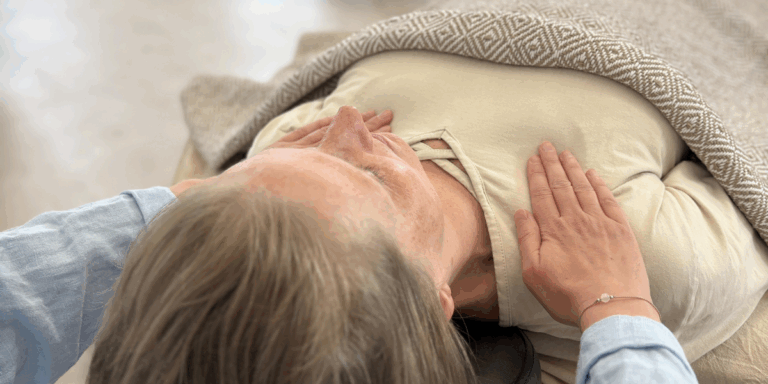
AUVO® treatments are built differently. The thinking has already been done, and it is part of the method. Every treatment follows the same fixed structure: the same sequence, the same areas, the same music, the same timing. Your client keeps their clothes on. The touch varies from gentle to firm, always in the same order. Your client agrees before you begin, and everyone knows exactly what will happen.
This changes two things.
The first is ethics. You do not have to decide in each session what is okay and what is not, because that has been decided in advance. Safety and trauma sensitivity are built into the method. Your task is to give the treatment exactly as taught. The boundaries are part of the structure, so they stay clear for you and for your client, and they do not depend on your mood or on the moment.
The second is presence. When the sequence is fixed, you do not need to think about what comes next. Your attention can stay with the person in front of you, which is where it belongs.
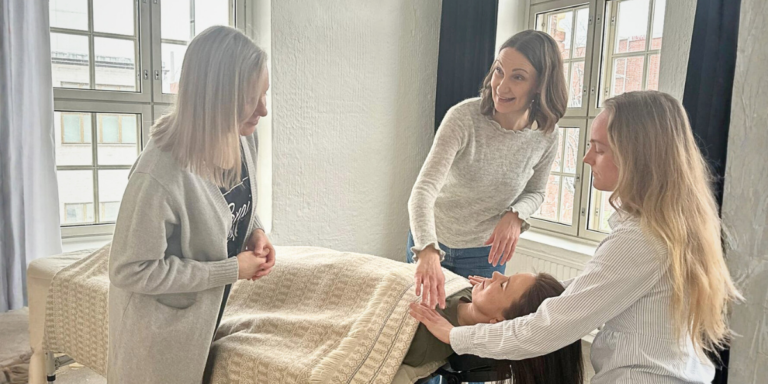
Fixed does not mean cold. AUVO® combines touch, music and presence. Jouko Kivimetsä developed the method over more than thirty years. Together we built the treatments and the trainings, and we both teach them.
How a treatment fits into your work with clients
AUVO® treatments are short and structured, so they fit around the sessions you already give. The shortest, AUVO® Snap, takes five minutes. Your client stays seated and fully clothed, and you need no treatment table or special room. Here are three ways to use it.
Before the conversation. A few minutes of touch can create safety and connection before the first word. Your client settles first, and the conversation starts from a calmer place.
After the conversation, to ground. At the end of an emotional session, a treatment can help your client relax, feel grounded and leave feeling safe. One coach told us that participants who were close to burnout were surprised how well Snap helped them reset their minds after a heavy topic, and they carried on with new energy.
As a visit of its own. The longen treatments, AUVO Balance and AUVO Deep, can also be a separate visit, one step in your client’s process, for example between conversation sessions. The structure is always the same, so your client knows what to expect and you know what you are offering.
It is also good to know what the treatment is not. It is not therapy, it does not diagnose or treat any condition, and it does not promise a particular result. What you can offer with it depends on your own training and on where you work. Your scope stays your scope.
Choosing a training
There are three AUVO® trainings, one for each treatment. AUVO® Snap is the quickest to learn: three weeks of online study at your own pace, and one half-day group meeting where you receive your diploma. You do not need any prior training, and it fits alongside a full-time job. AUVO® Balance (about 25 minutes) and AUVO® Deep (about 50 minutes) are longer treatments, and their practitioners work under a licence. Deep is a continuation for Balance graduates. You can start with Snap or Balance and learn the other treatments later, but you do not have to.
Think of the training as an addition to the work you already do, not as a new career. For a coach or a therapist, it can mean one more service that your current clients can easily say yes to, and an easy first step for new clients who want to try you.
To see how the trainings works, or to join the waitlist for the next AUVO® Snap training, visit the AUVO® Trainings page.
Try a treatment first, and ask me anything
You do not have to decide from a blog post. Touch is hard to explain, and the best way to understand AUVO® is to receive it. Book a treatment as a client and judge it with your own professional eyes. Did it feel safe? Could you offer it in exactly this way to your own clients? You can find an AUVO® practitioner here.
Or if you have questions, talk to me. I am a certified business coach and a workplace wellbeing coach, and I have studied a trauma-informed way of working. We can go through your work and your clients, and see how AUVO® would fit.
Book a time to talk with me.
You can also write to me at [email protected].
Anna Jalava
Co-founder and Master Trainer, Auvo Academy