
Certification and Licensing in a Touch-Based Method: What Quality Standards Can (and Can’t) Guarantee
Certification and licensing can feel like a simple stamp of approval—but in reality, they form a carefully built safety and quality framework. At Auvo Academy we see certification and licensing as a way to protect clients, support practitioners, and keep the AUVO® method consistent across Europe. Just as importantly, we believe in being clear about what these quality standards can – and can’t – guarantee, so expectations stay realistic and trust stays strong.
Touch-based wellbeing work is intimate by nature. It can be deeply calming, supportive for nervous system regulation, and meaningful in everyday recovery. Yet it also requires boundaries, competence, and humility. A certificate should never be used to promise outcomes that depend on a person’s life situation, stress load, or health history. Instead, it should signal that the practitioner has been trained to work safely, respectfully, and in a structured way.
Why certification and licensing exist in a touch-based method
In any modality where touch is central, a quality system exists for one main reason: safety. This includes physical safety (appropriate pressure, positioning, and contraindications), psychological safety (consent, dignity, boundaries), and relational safety (clear roles and professional conduct). For many clients, the ability to relax is inseparable from the feeling that “I can trust this person and this setting.” Certification and licensing are designed to support that trust with concrete standards rather than vague promises.
Certification also serves the practitioner. A structured training pathway gives language for what you do, why you do it, and when you should not do it. That matters in real life, whether you offer a 5-minute AUVO® Snap, or a longer AUVO® Balance or Deep session. A shared framework makes it easier to communicate with clients, cooperate with organizations, and stay grounded when someone asks for help that is outside your scope.
A defining feature of the AUVO® method is standardization: the treatment itself is designed to be delivered the same way, regardless of which practitioner performs it or where in the world the session takes place. The areas touched, the sequence, and the overall structure stay consistent across practitioners. This is not about removing the practitioner's individual touch – each practitioner brings their own steadiness and presence – but about ensuring the client always receives the same treatment. That predictability is itself part of what makes the method trustworthy: a client who has experienced AUVO® Balance once knows what to expect from it anywhere.
What a quality system is meant to protect These are the practical areas certification and licensing typically aim to cover in touch-based wellbeing services.
Client consent Clear permission for touch, with the right to pause or stop at any time.
Professional boundaries A clear practitioner role – supportive, not intrusive, and not dependent on personal disclosure.
Consistency The treatment itself is standardized: the same structure, sequence, and treatment areas, delivered the same way by every licensed practitioner, anywhere the method is taught.
Risk awareness Knowing when to refer out, adapt, or decline a session for safety reasons.
Ethical conduct Transparent communication, respectful marketing, and no inflated health claims.
Certification and licensing in a touch-based method: what standards usually cover
When people hear “certified,” they often imagine a single test. In reality, certification and licensing in a touch-based method usually combines multiple layers: training hours, supervised practice, technique assessment, and shared guidelines for professional conduct. The goal is not to create identical practitioners, but to ensure a reliable baseline: the client should experience a calm, structured approach, delivered with respect and competence. In practice, this means the treatment itself – what is touched, in what order, and for how long – stays the same from one practitioner to the next, so the experience doesn't depend on chance or improvisation.
In the AUVO® method, we emphasize the combination of therapeutic touch, music, and presence. That combination can support downshifting from high activation toward a calmer state, without making the session about fixing a person. A quality standard is especially important here: when a method aims to support nervous system regulation, the practitioner’s pace, clarity, and boundaries are part of the method itself.
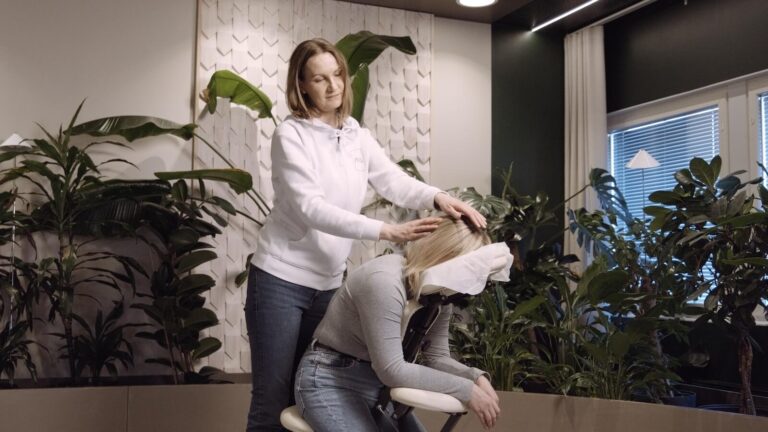
Quality frameworks also typically include documentation and “shared language.” This matters for B2B settings where AUVO® Snap is offered as a short, touch-based treatment designed for busy days, teams, or athletes. When the method is structured and the delivery is consistent, it becomes easier for an organization to understand what is being offered: a respectful, low-threshold pause that may support calming and recovery, with no need for participants to share personal issues.
Certification is not a promise of a specific result. It is a promise of a safer process, clearer boundaries, and a method delivered with care.
What quality standards can’t guarantee (and why that matters)
It is just as important to name the limits. A certificate cannot guarantee that every client will feel the same, respond the same, or reach a specific outcome. Stress and recovery are shaped by sleep, workload, relationships, health conditions, and life events. Even the most skilled practitioner cannot “override” a nervous system that is carrying a heavy load. Ethical providers avoid language that implies certainty, because certainty is not how human bodies and lives work.
Quality standards also cannot guarantee that touch will feel comfortable to every person in every moment. A professional framework can ensure consent and options, but each individual's preferences, history, and sensory thresholds are unique. This is why good providers avoid language that implies certainty: because certainty is not how human bodies and lives work. If you want to understand the broader context of touch as a human need, our article on touch as a basic need is a good starting point.
Realistic expectations that build trust These principles help clients and organizations understand what a licensed method can offer without overpromising.
Support, not substitution Touch-based wellbeing may complement healthcare, but it does not replace medical or mental health treatment.
Variability is in the experience, not the method The treatment itself stays the same each time, but how it feels can vary: one session might feel deeply restful, another simply 'a little calmer.' Both are valid responses to the same structured approach.
No guaranteed timelines Recovery is rarely linear, and quality standards should never imply guaranteed speed.
Choice stays with the client Consent is ongoing; the client can pause or stop without needing to justify it.
How to read a certificate: questions clients and partners can ask
If you are choosing a practitioner or inviting a method into a workplace, think of certification as a doorway to better questions. A trustworthy provider welcomes questions because transparency is part of safety. This is especially relevant in a touch-based method, where the client experience depends on respectful interaction, not just technique.
| Area | Typically covered by certification/licensing | Not guaranteed |
|---|---|---|
| Safety & ethics | Consent practices, boundaries, professional conduct, basic risk awareness | That every session feels comfortable for every person |
| Competence | Structured training, assessment, supervised practice, method consistency | A specific outcome (e.g., “stress will disappear”) |
| Consistency | Recognizable delivery across practitioners, shared guidelines | Identical experiences across countries, settings, or days |
| Scope | Clear definition of what the method is designed to do | Medical diagnosis or treatment results |
| Treatment structure | The same treatment areas, sequence, and format delivered identically across practitioners | A different or customized treatment based on personal preference |
For those considering training, it can be helpful to compare the public-facing standards with the actual pathway. You can explore the broader training structure via AUVO Practitioner Training and see where certification fits into competence, supervision, and ongoing support.
What Auvo Academy commits to: transparency, structure, and ongoing development
At Auvo Academy, we aim to build trust through clarity. That means we describe the AUVO® method in a grounded way: therapeutic touch, music, and presence, designed to support calming and stress relief, without claiming to “fix” a person or replace other care. It also means we keep our licensing and certification language practical: what training covers, what ethical expectations exist, and where the limits are.
For clients, one of the most meaningful signals of quality is not the certificate itself, but how it shows up in the session: a calm pace, respectful communication, and an atmosphere where your nervous system can settle. For organizations, it often shows up as reliability: practitioners who can deliver a short, touch-based AUVO® Snap in a consistent and respectful way, or provide longer treatments like AUVO® Balance and AUVO® Deep when appropriate.
A calm conclusion: standards are strongest when they stay honest
In the end, certification and licensing in a touch-based method is not about prestige. It is about care. It exists to support safety, competence, and consistency, so clients can feel more secure and practitioners can work with clear boundaries. When standards are used correctly, they make the experience more trustworthy and the conversations more transparent.
At the same time, the most ethical quality promise is a modest one: that the method will be delivered as trained, with respect, consent, and professionalism. From there, each person’s nervous system does what nervous systems do: responding in its own time, shaped by life, health, and context. When we set expectations this way, trust becomes steadier, and the space for genuine recovery becomes easier to access.
Want clarity before you book a treatment or apply for a training?
Explore the AUVO® method and our practitioner pathway, or contact us to discuss.